
Ontario Homeowner Guide
Can You Have a Basement Apartment in Ontario?
Ontario allows additional residential units on many residential properties, but turning a basement into an apartment involves more than adding a kitchen and bathroom. Zoning, building permits, fire and life-safety requirements, municipal rules and the individual property all matter.
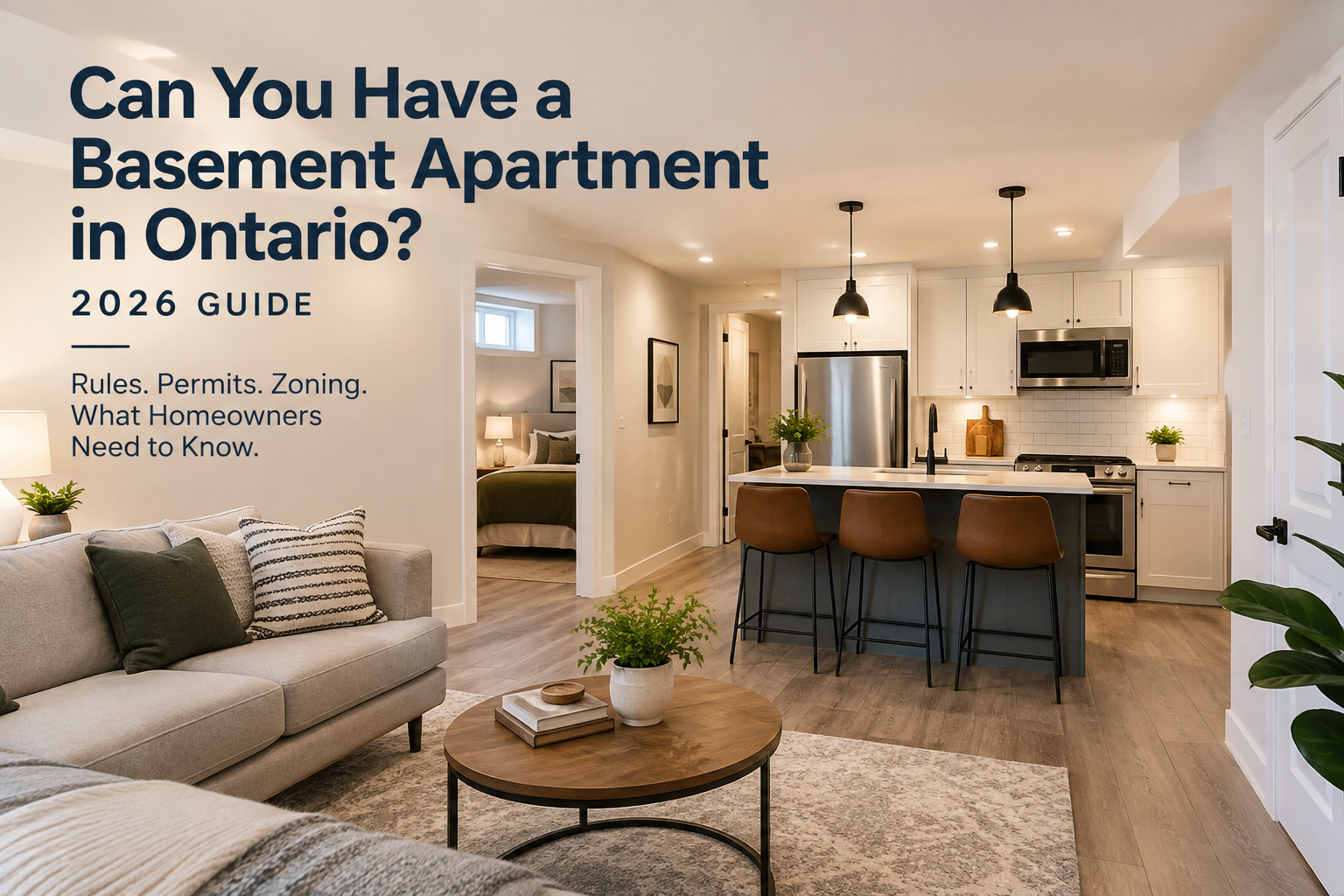
Quick answer: Yes. Basement apartments can be permitted in Ontario, and provincial planning rules allow additional residential units on many qualifying properties. However, an individual basement apartment still needs to comply with applicable zoning, building-permit, Building Code and other legal requirements. An existing basement apartment should not automatically be assumed to be legal simply because it is currently occupied or has existed for many years.
What Is a Basement Apartment?
A basement apartment is generally a separate residential unit located wholly or partly in the basement of a house.
Depending on the municipality and applicable legislation, you may also see terms such as:
- Additional residential unit (ARU)
- Additional dwelling unit (ADU)
- Secondary suite
- Second unit
- Accessory apartment
- Basement suite
- In-law suite
The terminology can differ, but the important issue is whether the space constitutes a separate residential unit and whether it complies with the requirements that apply to the property.
How Many Units Can You Have in an Ontario House?
Ontario’s additional residential unit framework generally provides as-of-right permission for up to three residential units on qualifying urban residential land.
For a qualifying detached house, semi-detached house or rowhouse, the provincial framework generally contemplates configurations such as:
- Three residential units within the main house; or
- Up to two residential units in the main house plus one residential unit in an ancillary building or structure.
A basement apartment could therefore be one of the residential units within the main house.
Some municipalities have gone further and permit additional units or different configurations in certain circumstances. This is why the municipality and individual property still need to be checked.
What Makes a Basement Apartment Legal in Ontario?
There isn’t one single province-wide checklist that makes every basement apartment legal. Several layers of regulation can apply.
1. Zoning
The property must comply with applicable planning and zoning requirements. Ontario’s Planning Act provides significant protection for additional residential units, but municipalities still administer zoning and property-specific development standards.
Depending on the property, relevant considerations can include parking, entrances, setbacks, servicing and other local requirements.
2. Building Permit
Creating a new basement apartment generally requires a building permit from the local municipality.
The permit process allows the municipality to review the proposed construction for compliance with applicable building requirements and other applicable law.
3. Building Code Requirements
The unit must meet the applicable Ontario Building Code requirements. Depending on the project and building, this can involve matters such as:
- Ceiling height
- Exits and means of egress
- Windows
- Fire separations
- Smoke alarms
- Carbon monoxide alarms
- Heating and ventilation
- Plumbing
- Electrical systems
- Structural changes
- Sound transmission
4. Electrical Work
Electrical work is regulated separately from the municipal building-permit process. Electrical alterations should be completed and inspected as required under Ontario’s electrical-safety framework.
5. Municipal Registration or Licensing
Some municipalities require additional residential units or certain rental properties to be registered or licensed. Others use different local processes.
This is one reason a homeowner should check the specific municipality rather than relying only on general Ontario information.
Existing Does Not Automatically Mean Legal
One of the most important things for Ontario home buyers to understand is that the physical existence of a basement apartment does not, by itself, prove that the unit is legal.
A listing might describe a property as having a basement apartment, second kitchen, in-law suite or separate entrance. Those features do not necessarily establish that the space was legally created or approved as a separate dwelling unit.
If the basement unit is important to your purchase, investigate its status rather than relying on the description alone.
Buying a House With a Basement Apartment
A basement apartment can make a property more attractive to a buyer who wants rental income, multigenerational living space or additional flexibility. But the status of the unit should be investigated during the purchase process.
Questions Worth Asking
- Was a building permit obtained for the basement apartment?
- Were the required inspections completed?
- Was final occupancy or other required approval obtained?
- Does the municipality have records for the unit?
- Does the current zoning permit the configuration?
- Is municipal registration or licensing required?
- Were electrical alterations properly inspected?
- Are there current tenants?
- What tenancy documentation exists?
- Is the buyer relying on the rental income to qualify for financing?
The appropriate investigation depends on the individual property and transaction. A buyer may need information from the municipality and advice from their real estate representative, lawyer, lender, insurer, home inspector or other appropriate professional.
Can You Convert an Existing Basement Into an Apartment?
Potentially. The first step should be determining whether the proposed unit can comply with the requirements applicable to the property.
Before spending significant money on construction, contact the municipality’s planning and building departments and determine what approvals are required.
A Typical Process May Include:
- Review the property’s zoning.
- Check municipal ARU requirements.
- Assess whether the basement can meet Building Code requirements.
- Prepare drawings.
- Apply for the required building permit.
- Complete construction.
- Arrange required inspections.
- Complete any municipal registration or licensing process that applies.
Do not assume that completing the construction first and obtaining approval later will be easier. Unpermitted work can create additional cost and complications.
Do You Need a Separate Entrance?
A separate exterior entrance is common for basement apartments, but whether a particular entrance arrangement complies depends on the design of the unit and the applicable building and zoning requirements.
Adding a new basement entrance can itself require a building permit and may involve structural work, grading, drainage, setbacks or other municipal requirements.
Do not cut a new basement entrance into a foundation based solely on the assumption that a separate entrance is allowed.
Do You Need Extra Parking?
Parking requirements need to be checked against the rules that apply to the property.
Ontario’s ARU framework limits certain municipal parking requirements associated with provincially protected additional residential units and permits tandem parking in applicable circumstances.
However, the exact parking situation can still differ by property and municipality. Do not assume that adding an apartment automatically requires a new driveway space—or that no additional parking consideration applies.
Basement Apartment Rules Vary by Municipality
This is where Ontario basement-apartment research becomes property-specific.
Provincial legislation establishes broad additional-unit permissions, while municipalities administer zoning, building permits and various local requirements. Some municipalities also permit more units than the basic provincial framework in certain circumstances.
Ontario Home Intel maintains municipal property guides covering local zoning, permits, ARUs and related property rules.
Niagara & Hamilton
Halton & Peel
Toronto & York
Thinking About Buying a Home With Rental Potential?
A basement apartment can affect a property’s income potential, financing, insurance, future renovations and resale. If the unit matters to your purchase decision, investigate its status before relying on it.
Frequently Asked Questions
Are basement apartments legal in Ontario?
Yes, basement apartments can be legal in Ontario. Provincial planning legislation protects additional residential units on many qualifying properties, but the individual apartment must still comply with applicable zoning, building, permit and other legal requirements.
Do I need a building permit for a basement apartment?
Creating a new second unit in a house generally requires a building permit from the local municipality. The municipality will identify the documents, plans and inspections required for the project.
Is an existing basement apartment automatically legal?
No. The fact that a basement apartment exists or is currently rented does not by itself prove that the unit was legally established or complies with applicable requirements.
Can I rent out my basement in Ontario?
A legal residential unit can generally be rented subject to the laws and requirements that apply to the property and tenancy. Municipal licensing or registration may also apply in some municipalities.
Can a basement apartment have its own kitchen?
A self-contained additional residential unit commonly has its own kitchen, bathroom and living or sleeping areas. The construction and installation of these facilities must comply with applicable building, plumbing, electrical and other requirements.
Can I add a basement apartment without changing the zoning?
Ontario’s additional residential unit framework provides as-of-right permissions on many qualifying properties, meaning a rezoning may not be required simply to permit the residential use. However, the individual property still needs to comply with applicable requirements, and a minor variance or other approval could be necessary depending on the proposed work.
How do I check whether a basement apartment is legal?
Start with the municipality. Ask about zoning, building permits, inspections and any registration or licensing records that apply to the property. Depending on the situation, additional professional review may also be appropriate.
Official Ontario Resources
Last reviewed: September 6, 2026.
Disclaimer: Ontario Home Intel provides general educational information only. This article is not intended as real estate, legal, financial, tax, lending, appraisal, inspection, engineering, building-code, planning or other professional advice. Provincial legislation, municipal zoning, building requirements and property-specific circumstances can change or differ. Verify information with the applicable municipality and other appropriate authorities or professionals before making a decision. Using this website or making an inquiry does not create a real estate representation relationship.